
Learning Chinese: A Practical Handbook
Introduction
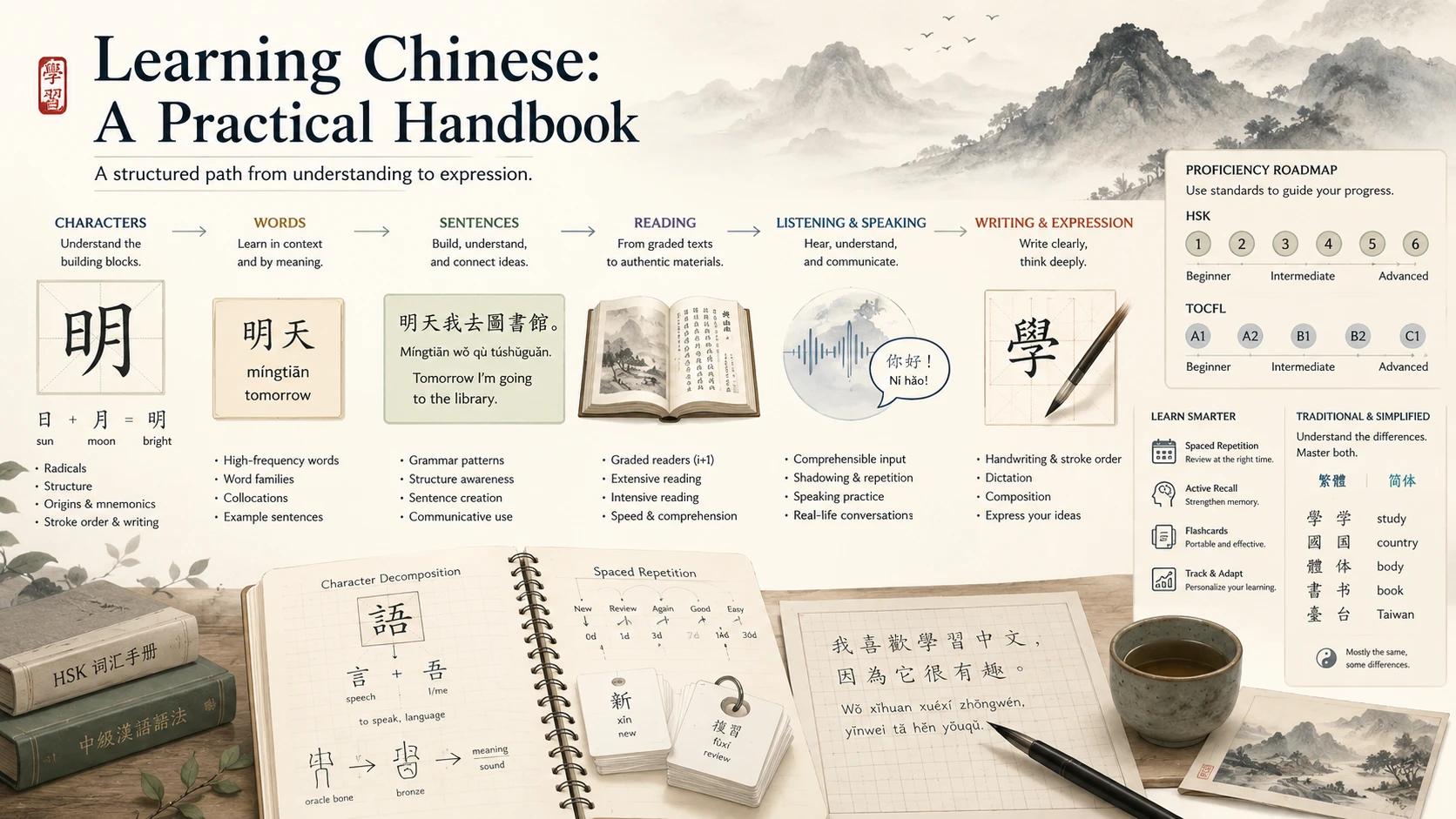
Learning Mandarin Chinese as a native English speaker presents unique challenges and opportunities. Chinese is a tonal language with a logographic writing system, which means reading and writing require mastering thousands of characters rather than an alphabet. Developing literacy often takes precedence, followed by listening and speaking skills. This report explores effective theories and techniques for Chinese language acquisition, emphasizing reading, writing, listening, and speaking (in that order of focus). We will examine structured proficiency frameworks (like HSK and TOCFL), traditional and modern methodologies (grammar-translation, spaced repetition, etc.), character learning strategies, reading techniques, and the use of flashcards. We also discuss how artificial intelligence (AI) enables personalized, adaptive learning and error analysis. Differences between China and Taiwan Mandarin usage, effective practice exercises, and insights from popular learning platforms (Duolingo, Skritter, Pleco, Anki) are included. An annotated bibliography of sources is provided at the end for further reference.
Proficiency Frameworks: HSK and TOCFL Mastery
HSK (Hanyu Shuiping Kaoshi) is the standardized Mandarin proficiency test in China. It recently expanded from 6 to 9 levels, ranging from beginner to advanced. The HSK prescribes vocabulary targets for each level—for example, old HSK Level 6 required knowing ~5,000 words, while the new HSK Level 6 corresponds to about 5,456 words (and Level 9 aims for 11,000+ words). Mastering HSK vocabulary and grammar is a common goal for learners, as HSK certification is often required for Chinese university admission or job applications. The HSK exam tests reading, listening, and writing via multiple-choice questions and short writing prompts, with a separate speaking test (HSKK) for oral proficiency. Preparing for HSK provides a structured progression in reading comprehension and writing skills, since one must recognize and understand a cumulative list of characters and words at each level.[1]
TOCFL (Test of Chinese as a Foreign Language) is the proficiency test used in Taiwan, with six levels grouped into three bands (A1–A2, B1–B2, C1–C2). TOCFL is conducted in traditional characters (繁體字), as opposed to the HSK's simplified characters (简体字). Learners targeting Taiwan often focus on traditional character forms and vocabulary used in Taiwanese Mandarin. The TOCFL's difficulty grading is considered stricter; for instance, TOCFL Band B (levels 3–4) can be challenging even for students who have passed HSK 5 or 6. Both HSK and TOCFL emphasize reading speed and accuracy—being able to quickly parse texts and choose correct answers under time pressure is crucial. Research on test performance notes that reading speed can be a deciding factor: understanding the text is not enough if you cannot read fast enough to answer all questions in time. Thus, using HSK/TOCFL as a roadmap can guide learners on which characters, words, and grammar patterns to learn at each stage, and practicing with past exam papers or mock tests builds the reading and listening stamina needed for success.
Mastery of these frameworks means not just rote memorization of word lists, but achieving an active skill level corresponding to each benchmark. For reading, this involves extensive practice with passages at the appropriate level and learning to infer meaning from context. For writing, it means being able to write short essays (for HSK 4 and above) and handwrite or type characters correctly. Many learners use the HSK/TOCFL levels to structure their study (for example, using HSK Level 1–2 as short-term goals, up to Level 5–6 for advanced fluency). Even if one does not plan to take the exams, the curated vocabulary lists and graded materials aligned with these levels are valuable resources. In summary, HSK and TOCFL provide clear milestones for Chinese proficiency and help prioritize learning materials—an English speaker can confidently progress from recognizing a few basic characters to reading newspapers and literature by following the level-by-level buildup of language skills.
Traditional Learning Approaches and Grammar
Grammar-Translation Method in Chinese Learning
One historically dominant approach to language learning is the Grammar-Translation Method. In this method, grammar rules are taught explicitly and practiced through translation exercises between the target language and the native language. Chinese textbooks in the past often used this approach: a lesson would introduce a grammar rule (say, the 把 construction or 了 for aspect), list example sentences, then have students translate sentences to and from Chinese to apply the rule. The focus is on grammatical accuracy and vocabulary. As one source notes, Grammar-Translation treats language learning as essentially learning vocabulary plus grammar rules, with memorization of rules followed by translation to reinforce them.[2] In Mandarin courses using this method, an English-speaking student might memorize the usage of 是…的 for emphasizing details in a sentence, and then translate multiple English sentences into Chinese using that structure.
The Grammar-Translation method has the advantage of providing a clear understanding of syntax and structure. For Chinese, which has a very different syntax and uses particles (了, 过, etc.) and measure words that English lacks, a contrastive grammar explanation can be very helpful. For example, explicitly learning that Chinese does not conjugate verbs for tense, but uses time phrases or aspect particles, addresses a major source of confusion for English speakers. Translation exercises can also ensure a learner pays attention to details (like the correct measure word or the placement of 也/都 in a sentence). This approach tends to emphasize reading and writing (especially writing sentences and translating texts), which aligns with our first priorities of literacy. It can rapidly build reading ability in the early stages because students constantly parse written sentences and construct their own.
However, grammar-translation often neglects listening and speaking. A student might be able to analyze a sentence like Wǒ bǎ shū fàng zài zhuōzi shàng ("I put the book on the table") and explain the grammar, but be much less confident in pronouncing it or using it spontaneously. Recognizing this shortcoming, more recent pedagogies incorporate communicative practice. In contrast to Grammar-Translation's focus on written form, the Direct Method and Communicative Approach encourage teaching through spoken Chinese without translation, to build intuitive language habits. Still, Chinese teachers often blend methods—they stress grammar explanations (since Chinese structure can be non-intuitive for English speakers) but also create opportunities for dialogue and immersion. The consensus in Chinese as a foreign language education is that grammar instruction remains important for adult learners , but it should be balanced with usage. An effective strategy is to learn the grammar rule (e.g. the "把" construction), practice it in drills or translations to solidify understanding, and then use it in a communicative context (like describing something in Chinese without referring to English).
In summary, the Grammar-Translation approach provides a strong foundation in reading and structural accuracy for Chinese learners. It aligns with the reading-focused phase of learning, ensuring one can dissect and construct sentences accurately. But it must be augmented with listening and speaking practice to achieve well-rounded proficiency. Many successful learners report starting with a grammar-focused strategy (to decode written Chinese and build vocabulary) and later shifting to more communicative practice once they have a base in the language's structure.
Spaced Repetition and Memory Techniques
Memorizing the vast number of Chinese characters and words is a significant hurdle for learners. Spaced repetition is a proven memory technique to overcome the forgetting curve. The principle is simple: instead of cramming and repeating a new word or character many times in one sitting, you review it at gradually increasing intervals of time. Research on the spacing effect shows that information is retained much better when reviews are spread out over time rather than massed together. In practice, a spaced repetition system (SRS) will quiz you on a character just when you're about to forget it, reinforcing the memory and then scheduling the next review further out. This leverages our psychological learning process—each successful recall strengthens the memory and allows the interval to lengthen.
Modern learners almost inevitably encounter SRS through flashcard apps like Anki, Pleco, or Skritter. These tools implement algorithms (often based on the SM2 algorithm from SuperMemo) to manage review timing. For example, if you learn the character 漢 (hàn, "Chinese [language]") today, the app might show it again tomorrow, then 3 days later, then 10 days later, and so on, each time asking you to recall the character's form and meaning. If you ever fail to remember it, the card's schedule resets to appear more frequently until you solidify it. Studies and anecdotal evidence strongly support that spaced repetition dramatically reduces the total study time needed to learn a large vocabulary, as it optimizes review to when it's most needed.
This technique is especially well-suited to Chinese, where one must memorize not only meanings but also pronunciations (tones) and written forms. As one expert notes, learning Chinese characters without an SRS is daunting—Chinese schoolchildren spend years writing characters daily to remember them, which is impractical for most adult learners. SRS flashcards offer a shortcut by breaking down the task: you see a character, actively recall its pronunciation/meaning or how to write it from memory (active recall practice), and get immediate feedback. The combination of active recall (forcing yourself to produce the answer) and spaced repetition is highly effective. Active recall strengthens memory more than passive review, and spaced scheduling ensures you don't waste time reviewing things you already know well.
To use spaced repetition well, it's important to keep the reviews consistent—daily if possible—so that the algorithm can do its work. The habit of daily flashcard review (even 10–15 minutes) can lead to mastering several thousand characters over time with surprisingly good long-term retention. Many learners tackle HSK word lists or other frequency lists using Anki decks, which can be downloaded or custom-made. In doing so, one must be careful: flashcards excel at training recognition and recall in isolation, but they do not automatically teach usage or comprehension in context. It's common to supplement flashcards with real reading and listening; in fact, reading itself provides natural spaced repetition of common words in varied contexts. One study points out that encountering words in reading or listening also spaces out repetitions (though less systematically), and has the added benefit of contextual learning.
Overall, spaced repetition is a cornerstone technique for Chinese learners. It aligns with the need to memorize characters and words efficiently, preventing the frustration of forgetting characters shortly after learning them. By incorporating SRS into a study routine—for example, reviewing flashcards each morning—learners can ensure that the time invested in learning characters yields permanent knowledge. The graph below illustrates how spaced reviews (teal curve) interrupt the natural forgetting curve (grey) and flatten it over time, resulting in much higher retention percentages as days and weeks pass :
Spaced repetition combats the forgetting curve by reviewing items just before they would be forgotten. Each review strengthens memory (raising the curve), allowing longer intervals before the next review.
Flashcards as a Learning Tool
Flashcards are one of the most popular tools in language learning, and for good reason. In Chinese learning, flashcards (physical or digital) typically have a character or word on one side and the pronunciation and meaning on the other. They harness active recall (you see one side and must produce the information on the other) and can be easily used with spaced repetition algorithms, as discussed above. Experts note that flashcards offer "much bang for your buck" for certain tasks—no other method allows you to learn so many new words so quickly with high retention.[3] For a native English speaker faced with learning, say, 3,000 new Chinese characters, flashcards provide a structured, efficient way to drill them.
The advantages of flashcards in Chinese are clear: you can isolate specific bits of information (e.g. the character 机/機—jī—meaning "machine") and focus on them until they stick. You can shuffle them, mix old and new, and tailor the deck to your needs (such as including example phrases or adding images). Using a flashcard app like Anki or Pleco, one can quiz themselves on recognition (seeing 漢 and recalling "hàn, Chinese"), on production (seeing "Chinese (language)" and recalling 汉), on tone (listen to "hàn" audio and think of the character), etc. Flashcards also fit easily into short pockets of time, making learning convenient—e.g. reviewing 10 cards while commuting.
However, it's important to acknowledge the limitations of flashcards. As Hacking Chinese author Olle Linge points out, flashcards simplify language to isolated pieces, so they cannot teach you everything you need for true proficiency.[4] Knowing a word on a card doesn't guarantee you'll recognize it when spoken quickly in a conversation, or that you can use it correctly in a sentence. For instance, you might memorize the word 意思 (yìsi, meaning "meaning/idea or interesting" in phrases) on a flashcard, but still be puzzled by the phrase méi yìsi ("boring" or literally "no meaning") until you see it in context. Flashcards also don't inherently teach grammar or nuance. Thus, critics warn that exclusive reliance on flashcards could lead to a skewed skill set: one might have thousands of words "known" in Anki, but struggle with basic listening or speaking in real life.
The consensus is to use flashcards strategically. They are fantastic for boosting recognition vocabulary—e.g. learning the basic meaning and pronunciation of lots of characters—as a stepping stone to reading. One method is to pre-learn characters or words with flashcards and then immediately reinforce them by reading them in actual texts. Flashcards can also be targeted to personal weaknesses (for example, making cards for characters you consistently mis-write or mispronounce). When integrated into a broader study routine that includes reading, listening, and speaking, flashcards accelerate vocabulary acquisition without replacing other skills.
In recent years, digital flashcard platforms have added features to make learning more comprehensive. For example, some allow adding audio (so you also test listening), images or mnemonic hints, or even cloze (fill-in-the-blank) sentences instead of single words. This moves a bit beyond the single-word isolation issue. Nonetheless, a key piece of advice is: do not get addicted to only flashcards. They should serve the higher goal of enabling you to read books, listen to conversations, and participate in communication. As one resource puts it, comprehensible input and communication are irreplaceable; flashcards simply support those by ensuring you have the building blocks (characters and words) ready to go.[5]
Summary of flashcard use: They are a highly effective tool for memorization (especially when combined with spaced repetition) and can dramatically build up your Chinese character recognition and vocabulary. Use them to master characters, pronunciations, and meanings, but always combine them with context practice. For instance, after drilling flashcards for a set of new words, try to spot those words in a reading passage or use them to write a few sentences. This way, flashcards become an aid to reading and writing fluency, rather than an end in themselves.
Chinese Characters: Analysis and Learning Strategies
One of the most distinctive aspects of learning Chinese is mastering Chinese characters (漢字). Unlike an alphabet, characters encode meaning and sound in intricate, non-linear graphs. For an English speaker, this is initially daunting, but linguistic analysis of characters reveals patterns that can be exploited for learning. Key techniques include understanding character structure (phonetic and radical components), using mnemonic devices, and studying the etymology or origin of characters.
Phonetic-Semantic Character Structure
The majority of Chinese characters are phonetic-semantic compounds. Linguists estimate that at least 80% of all Chinese characters consist of a semantic component and a phonetic component.[6] This means a character is often composed of one part that hints at its meaning (the radical) and another part that suggests its pronunciation (the phonetic). For example, consider the character 洋 (yáng, "ocean"). It can be broken into the water radical 氵 on the left (semantic hint, since ocean is related to water) and 羊 ("sheep", pronounced yáng) on the right, which serves as the phonetic hint. Thus 洋 is pronounced yáng, similar to 羊, and has a meaning related to water. This system isn't perfectly consistent, but it's common enough that learning to recognize phonetic components can dramatically improve a learner's ability to guess pronunciations and remember characters. Native Chinese readers unconsciously use this strategy—when they see an unfamiliar character, a rule of thumb is "有邊讀邊" ("read it by its side [component]"), meaning they look at the phonetic part to approximate the reading.
For learners, this means that rather than treating each new character as an arbitrary drawing, you should decompose characters into parts. Identify the radical (often giving a broad category of meaning—e.g. 氵 often relates to water/liquids, 扌 relates to hand/actions, 心 or 忄 relates to feelings or mind) and identify if there's a recurring phonetic element. Over time, you will notice patterns: e.g., many characters containing 青 (pronounced qīng) have a -ing sound (情 qíng, 請 qǐng, 清 qīng), or characters with 馬 on the right often have a -ma or -ma sound (媽 mā, 罵 mà). By one account, paying attention to phonetic components can give you clues to the pronunciation for about 60%–80% of characters in modern use—though tones may differ and there are exceptions due to sound changes over time.[7]
Incorporating this into study: when learning a new character, note its components. For instance, if you learn 撞 (zhuàng, "to collide"), break it into 扌 (hand radical, implying an action) + 童 (phonetic component, pronounced tóng, but in this character gives the sound zhuàng). This tells you it's an action (maybe done with a hand or object) and if you already knew 壯 (zhuàng, which has the same phonetic part), you can connect the pronunciation. Many textbooks and apps now explicitly teach characters by decomposition. Leveraging phonetic components accelerates character acquisition, because you start to make educated guesses and see relationships between characters rather than viewing them as random strokes. It effectively turns character learning from pure memorization into a pattern-recognition task, which is much easier once the patterns click.
Radical-Based Mnemonics
Radicals are the graphic components of characters that often indicate meaning or category. There are 214 traditional radicals, and every character is categorized under one of them in dictionaries. Radicals can be standalone characters themselves (e.g. 木 is the character for "tree" and also the radical meaning wood), or they can be variant forms when used as components (e.g. the "water" radical 氵 is a variant of 水). Using radicals as mnemonic aids is a powerful technique. The idea is to make a story or image combining the radical and other parts to recall the character's meaning and sometimes its sound.
For example, take the character 休 (xiū, "to rest"). It is composed of 亻 (person radical) next to 木 (tree). One common mnemonic: a person leaning against a tree suggests "rest" or taking a break. This little story ties together the components into a meaningful image, so you remember 休 = person + tree = rest. Many learners, when they first encounter characters, use imaginative descriptions like "look, this part looks like a roof, and underneath is a pig—this is the character for home/family, 家, which historically is a pig under a roof." Such pictorial mnemonics, championed by books like Heisig's Remembering the Hanzi, don't always reflect the true historical origin but are effective memory hooks. In Heisig's method, each component (radical or phonetic) is assigned a keyword meaning, and learners create short stories for how those components together relate to the character's meaning. This method willingly ignores real etymology when necessary in favor of imaginative consistency. For instance, Heisig might say "商 (business) consists of 章 (badge) on top of 冏 (window)—imagine a merchant hanging his badge on the shop window to show it's a place of business." The actual historical formation may differ, but if the story is memorable, the student can recall the character.
On the other hand, one can also use a "semi-etymological" approach: learning the actual meanings of components and then forming mnemonics that align with them. For example, knowing that 好 (hǎo, "good) is literally a woman (女) and a child (子) together—in ancient Chinese culture, having a son was considered good—gives a cultural mnemonic that is true to the character's origin. Sometimes the real etymology is complex or not intuitive, in which case making up a personal story is fine. The key is that by breaking characters into smaller known pieces (radicals/components), you dramatically reduce the mental load. Instead of 10 strokes floating in space, you see 2–3 familiar chunks. Over time, characters start "making sense" rather than being random drawings.
Many learners find radical-based mnemonics essential when starting out, because the first few hundred characters have to be absorbed somehow, and pure rote copying is arduous. An English speaker's memory is more likely to latch onto a vivid image or story than abstract strokes. Apps like Skritter, Outlier Dictionary, or Pleco (with add-ons) often provide mnemonic hints or the logic behind a character. As you learn more characters, you might rely less on explicit mnemonics because you can recognize components and recall characters more naturally. But whenever you encounter a difficult-to-remember character, consciously devising a mnemonic can save a lot of frustration.
Etymology-Based Learning
Another enriching approach is to study the etymology of Chinese characters—how they evolved from ancient pictographs or combinations. Chinese characters have a history stretching back over 3,000 years, with many originally derived from drawings of objects (pictographs) or abstract symbols that combined to express ideas. Understanding a character's origin can sometimes make it much more memorable. For instance, the character 血 (xuè, blood) might seem abstract now, but originally it was a pictograph of a container of blood. Knowing such facts can create an "aha" moment that links the character to a concrete image in your mind.
However, pure etymology can be a double-edged sword for learners. On one hand, it's fascinating and can illuminate connections (e.g., the character 吳 (old form of 吴, a surname/state name) originally depicted a person blowing a flute—interesting but not obviously relevant now). On the other hand, Chinese characters have undergone simplifications and changes that mean the historical meaning of parts is often obscured or lost in the modern form. A classic example mentioned by blogger John Pasden: the component 又 appears in many characters as a component, but historically it might represent a hand or some other concept, and those ancient meanings aren't apparent to modern learners.[8] Trying to learn etymology for every character can become "ridiculously complex and just places more burden on the student". Some characters went through phonetic loans or underwent changes where the original pictograph no longer resembles the current meaning at all.
A practical approach is to use etymology selectively: when the origin is straightforward and helpful, take advantage of it; when it's convoluted, don't hesitate to rely on a simpler mnemonic. For example, it helps to know 愛 ("love") used to have a 心 (heart) in it—the traditional character is 愛—and the simplified form dropped the heart, which is a poetic loss as one teacher humorously noted ("love in simplified has no heart" ). This tidbit not only helps you remember 愛 vs 愛, but also gives cultural insight. Conversely, a character like 繁 (fán, "complex, numerous") has an etymology involving a symbol for "poison" under "絲" (silk) etc., which might not aid memory; in that case, a self-created story about how "complex" it is with many components might do just as well.
There are resources (like the Outlier Linguistics dictionary or etymology textbooks) that specifically teach characters by their historical development. These can be very engaging for those who enjoy the linguistic aspect. Even a casual browse can deepen your appreciation—for instance, seeing oracle bone inscriptions of 木 or 人 that clearly look like a tree or a person. Ultimately, whether you use imaginative mnemonics or true etymology, or a mix, the goal is to leverage the character's components to make it meaningful to you. Rather than brute-force memorizing stroke sequences, you build a mental web of associations: sound, parts, story, origin.
Character learning summary: By analyzing characters into phonetic and semantic parts, using radicals and mnemonics, and understanding origins where useful, learners can approach Chinese characters systematically. This transforms character learning from an overwhelming memorization task into a more logical process, where each new character fits into a network of familiar elements. Over time, an English-speaking learner will start to "think in characters"—seeing the component patterns and even predicting meanings or sounds—which is a major breakthrough toward literacy.
Reading Strategies for Chinese
Reading is often the first big goal for Chinese learners, and rightly so—reading extensively opens up the vast world of Chinese literature, news, and daily life texts, and it reinforces all other language skills. However, learning to read Chinese is a gradual process that requires building up vocabulary and character recognition step by step. Here we discuss strategies to go from basic literacy to advanced reading proficiency, including graded readers, extensive vs. intensive reading, increasing reading speed, and tackling authentic texts like newspapers.
Graded Readers and Extensive Reading
One of the best tools for learners transitioning from beginner to intermediate reading is the graded reader. Graded readers are books (often short stories or novellas) written using a limited set of vocabulary and simple grammar, tailored to specific proficiency levels. For Chinese, graded readers typically adhere to character counts aligned with HSK levels or other standards (for example, a Level 1 graded reader might use only 300 unique characters). The idea is to provide reading material that is easy enough to be understood extensively (almost fluently) without stopping to look up every other word. Extensive reading means reading for pleasure or general understanding rather than for study, and doing so at a level where you recognize most words.
Research in second-language acquisition strongly supports extensive reading as a way to boost language skills. We learn best when what we are reading (or listening to) is easily understood (i.e. comprehensible input). At an optimal extensive reading level, a learner knows 98% or more of the words, so the reading is smooth and enjoyable. Graded readers fulfill this by using controlled vocabulary and a lot of repetition of new words in context. A Mandarin Companion graded reader, for instance, might introduce the word 小偷 (xiǎotōu, thief) and then use it multiple times in the story about a stolen something, reinforcing that word in a natural way. By reading these stories, learners painlessly acquire new vocabulary and grammar patterns because they can infer meanings from context and see proper usage repeatedly.
The benefits of graded extensive reading are numerous: it builds reading fluency and speed, increases vocabulary, and even improves writing and speaking indirectly. Learners often report that after reading several graded readers, they feel a jump in confidence—"yes, I can actually read a book in Chinese!"—which is hugely motivating. Moreover, because you're understanding concepts in Chinese rather than translating word by word, you start to think in Chinese while reading. Decades of research on extensive reading show outcomes like higher test scores, faster reading, more fluent use of language, intuitive grasp of grammar, and better overall comprehension for learners who read a lot in the target language.[9] In Chinese, where moving from elementary texts to native-level texts is particularly challenging, graded readers bridge the gap.
To use graded readers effectively: start at a level where you're comfortable. If a page has too many unknown characters (causing "reading pain" where you labor over every line[10]), then it's above your extensive reading level—perhaps drop down a level or review some vocabulary first. Aim to read without a dictionary as much as possible, only looking up occasional key words. Over time, push yourself to higher levels. Many series exist (e.g., Mandarin Companion, Chinese Breeze, etc.), and some are now available with audio, which can double as listening practice.
Intensive vs. Extensive reading: While extensive reading should form a big part of your practice, there is still a place for intensive reading. Intensive reading means tackling texts that are a bit beyond your comfortable level in order to learn new language points. For example, you might take a short news article or a graded reader above your level and study it with a dictionary, fully annotating the new words and analyzing the sentences. This is slower and more study-like. It's very useful for learning new vocabulary and grammar in context and for slowly acclimating yourself to harder content. Many Chinese learners alternate: do intensive reading (e.g., one paragraph of a newspaper with careful lookups) to push your knowledge, then do extensive reading (e.g., a fun graded story) to consolidate and enjoy. The science-backed advice is to spend a lot of time in extensive reading since that's where fluency comes, and use intensive reading more sparingly to broaden your language base.
Speed Reading and Character Recognition Skills
Reading Chinese quickly is a skill that develops with practice. Initially, even after knowing a character, you may take a moment to recall it, unlike reading an alphabet which for literate adults is almost instant. As you read more, character recognition becomes more automatic. One common observation is that timed exams like the HSK and TOCFL put pressure on reading speed—you might comprehend a passage well, but run out of time to answer questions. Thus, consciously working on reading speed can be valuable. This doesn't mean skimming without comprehension, but rather training to recognize characters and common words rapidly and to not subvocalize too much (silently pronouncing each word can slow you down).
One Chinese learning expert recounts how failing a proficiency test was a wake-up call: "I understood the texts and got most questions right, but I wasn't even halfway through when time nearly ran out… Was this a reading comprehension test or a reading speed test?".[11] The reality is, to demonstrate reading proficiency, you need to automate a lot of the process so that you can cover more ground in less time. Someone who can read a 500-character story in 5 minutes is clearly more proficient than someone who needs 15 minutes for the same task, even if both answer questions correctly. The way to get there is practice and volume: by reading extensively, your brain starts recognizing common character combinations as chunks (words, set phrases) and your eyes move faster. You stop needing to internally "translate" or even "pinyin-ize" what you see; instead, meaning arises directly. At that point, reading Chinese can approach the speed of reading English.
There are specific exercises to improve character recognition speed. One is scanning practice—take a page of text and try to visually find specific characters or terms as quickly as possible (like a word search). Another is timed re-reading—read a passage with comprehension, then re-read it trying to shave off time, training yourself to process faster. Some advanced learners use tools or apps that flash characters at increasing speeds (a form of speed-reading training). It's also useful to practice reading without pronouncing in your head—try to see if you can understand characters by sight without "hearing" their pronunciation each time. This is tricky with Chinese due to the script, but necessary for real speed. Extensive reading naturally helps break the habit of subvocalizing, because as you get absorbed in a story, you focus on ideas, not individual syllables.
As a benchmark, fluent native-level reading of Chinese might be around 300 characters per minute or more for average difficulty text. Learners won't reach that immediately, but going from 30 to 100 to 200 cpm is achievable with effort. Faster reading not only helps in tests but makes using Chinese in daily life more feasible (for example, reading signs, menus, subtitles, or chat messages quickly).
Tackling Newspapers and Authentic Texts
Many learners aspire to read Chinese newspapers to access current events and more sophisticated content. Newspaper comprehension is an advanced skill because news articles often use formal vocabulary, idiomatic expressions, and assume cultural knowledge. They also tend to be written in a concise, sometimes bureaucratic style (especially official news). That said, reading news is immensely rewarding: it significantly expands vocabulary (covering politics, economics, technology, etc.), deepens cultural insight, and keeps you informed. It's also real-world language—the phrases and constructions you see in news are often useful in formal writing or educated discussions.
When approaching newspapers, a few strategies can help:
- Start with familiar topics. Choose articles about subjects you already know or care about (e.g., sports, technology, entertainment). This gives you context and likely some known vocabulary, making it easier to guess unknown words.
- Leverage bilingual or learner resources. Initially, you might use a news-for-learners site like The Chairman's Bao, which provides news articles rewritten at various HSK levels. Or use a tool like DuShu or FeedReader that shows pop-up definitions. Some learners use parallel texts (Chinese article with English translation side by side) to ease in. University libraries sometimes have books that compile bilingual news articles for study.
- Check the first paragraph for summary. Chinese news articles often have a summary lead. Reading just the first 1–2 sentences can give you the gist, which aids comprehension of the details that follow. Use context and skip details. It's not necessary to understand 100% of an article to get the main ideas. If you hit a dense section (like a long quotation full of names and titles), consider skimming it. Focus on who did what, when, where—journalistic writing in Chinese often follows that structure too.
- Build a news vocab journal. Keep track of common words that appear in headlines and articles: terms like 召開 (zhàokāi, to convene [a meeting]), 表示 (biǎoshì, to express/state), 年度 (niándù, annual)… these repeat a lot. With spaced repetition or regular review, you can internalize this "newspaper lexicon."
Over time, reading news becomes easier as you accumulate the formal lexicon and background knowledge. You'll also pick up set phrases and idioms that are prevalent in media. For instance, phrases like 愛恨交織 ("love-hate intertwined") or 引發熱議 ("spark heated discussion") might show up often, enriching your language. Moreover, news reading teaches you about the world through Chinese perspective, providing "cultural context and current affairs" knowledge that is invaluable in advanced language competency.[12]
Some learners worry that reading news might teach them overly formal or stiff language. There is some truth to this—newspaper Chinese can be more formal than daily conversation. However, it still greatly enhances reading comprehension and even listening (since news broadcasts use similar language). And if you balance it with other reading (like novels, web novels, or social media posts), you'll get a full spectrum.
In sum, reading strategies for Chinese should evolve with your level: begin with graded readers and extensive reading to build a foundation and fluency ; use intensive reading for challenging material to push your vocabulary; practice speed reading techniques as you become intermediate to advance your character recognition efficiency; and gradually introduce authentic texts like news, adjusting your approach with the tips above. Reading is a skill that compounds—the more you read, the easier and more enjoyable it becomes, unlocking a virtuous cycle of improvement.
Listening and Speaking Skills Development
While reading and writing build the foundation of vocabulary and structure, listening and speaking are equally crucial skills for communication. For native English speakers, Mandarin's tones and unfamiliar sounds can make listening comprehension particularly challenging, and speaking requires mastering pronunciation and tone accuracy. Here we outline approaches to improve listening and speaking, which often go hand-in-hand, since listening provides the input model for speaking output.
Listening Practice Techniques
To get better at understanding spoken Chinese, exposure and active practice are key. One effective method is graded listening, analogous to graded reading. Begin with slow, clear audio resources designed for learners (for example, the "Slow Chinese" podcast or Mandarin Companion's audiobooks that accompany graded readers). As you progress, move to normal-speed materials on familiar topics, and then to a wide range of native media (TV shows, radio, podcasts). It's important to train your ear to Mandarin's phonetics and tones. At first, you might struggle distinguishing certain sounds (qì and xì, or -an vs. -ang endings, etc.), but repeated listening will attune you to them.
One proven exercise for listening is dictation (听写). Dictation involves listening to an audio clip (could be a single sentence or a short paragraph) and writing down what you hear, either in characters or pinyin. This forces you to pay attention to every syllable and tone. The rationale behind dictation is to practice segmenting the flow of speech into words—essentially training yourself to hear where one word ends and the next begins. For Chinese, where there are no spaces in written text and spoken words can blend, this segmentation skill is vital. In dictation practice, you might replay a sentence multiple times to puzzle out each syllable, which develops your ability to catch fast speech. Research indicates that such training improves phoneme discrimination (hearing differences between similar sounds) and builds an "aural vocabulary"—words you understand by ear, not just by sight. As one source describes, dictation helps with recognizing sounds and word boundaries, which is crucial for real-time comprehension.[13] Chinese teachers in schools often use 聽寫 for students to practice characters (the teacher says words aloud, students write the characters), but here we emphasize it for adult learners as a listening tool. You can start by dictating single sentences from your textbook's audio or use dedicated apps (some apps play audio and have you type what you hear, gamifying the process).
Another technique is shadowing: listening to a sentence and then immediately trying to repeat it exactly (with the same pronunciation, tone, speed). This can be done with podcasts or any recorded dialogue. Shadowing improves your listening precision and speaking fluency together. You learn to mimic the native pronunciation and intonation, and it forces you to process the sounds quickly. If shadowing full-speed Mandarin is too hard, you can shadow slower recordings or even just repeat after a speaker with a slight pause.
Active vs. passive listening: Both have value. Passive listening (having Chinese radio or music in the background) can help with immersion and familiarity, but active listening (where you are fully engaged, possibly taking notes or answering questions about what you heard) is needed to really push your comprehension skills. A good practice is to use podcasts or videos with transcripts/subtitles: listen first without text and see how much you catch, then listen again with the transcript to fill gaps. Over time, you can challenge yourself with more complex content: e.g. start with learners' podcasts, then graduate to native podcasts on topics you like (technology, travel, etc.), and eventually perhaps talk shows or movies.
Resources: In addition to podcasts, consider using platforms like YouTube (many channels for Chinese learners, and also native content like vlogs), or apps like FluentU or VoiceTube that provide videos with interactive captions. For pure audio, Chinese radio dramas or audiobooks can be great once you have intermediate level—they expose you to storytelling language and different voices/accents.
Speaking and Pronunciation Practice
Speaking Mandarin fluently involves several sub-skills: correct pronunciation of initials/finals, tone accuracy, proper use of vocabulary and grammar in real time, and an appropriate manner of speaking (formal vs casual, etc.). English speakers often find pronunciation to be the first hurdle—Mandarin has sounds not in English (ü, the unaspirated vs aspirated consonant contrasts like b/p, the sh vs x vs s distinctions) and of course tones (the pitch contours that distinguish meaning). Mastering tones is essential; mispronouncing tones can lead to misunderstandings (saying mǎ (horse) when you meant mā (mother), for instance).
A recommended early practice is to focus intensively on pronunciation in the first few weeks of learning. Use pinyin charts to practice each syllable and tone combination. Many online tools play audio for each syllable (e.g., pinyin pronunciation charts with recordings). Imitate them and even record yourself to compare. Pay attention to tone pairs (how tones change or get slightly modified when spoken in sequence)—this can be drilled with common word pairs. It's worth noting that good pronunciation is easier to establish at the beginning than to fix later, so investing time here yields dividends.
For speaking proficiency, one-on-one conversation practice is invaluable. If possible, engage a tutor or language exchange partner early on. Start with simple topics (introductions, daily routines) and gradually incorporate new words/structures as you learn them. Speaking reinforces what you learn in a powerful way—when you actively use a word, it sticks much better than if you only see it on paper. Also, making errors in speaking and getting corrected is a fast way to learn (e.g. saying a sentence and the partner teaches you a more natural way to phrase it). With today's technology, finding speaking opportunities is easier: you can use platforms like italki for tutors, HelloTalk or Tandem for finding exchange partners, or even AI chatbots for simulation of conversation.
Structured speaking exercises can also help: for instance, practice sentence composition—take a new grammar pattern and try to make your own sentences aloud. Or do role-play scenarios: pretend you are buying something at a store or ordering food, and speak out loud the dialogue (even if you're alone, this builds fluency and confidence). Another fun exercise is story retelling—read a short story or watch a short video, then attempt to summarize or retell it in Chinese. This forces you to activate vocabulary and circumlocute if needed (great practice for finding alternate ways to express something when you forget a word).
An often overlooked aspect is pronunciation feedback. If you have a native speaker friend or tutor, ask them to point out pronunciation issues. Sometimes, English speakers might consistently mispronounce certain tones (a common one is making third tone too low and short, or mixing up second and fourth tone intonation). Targeted practice on troublesome sounds or tones—tongue-twisters, minimal pair drills (e.g. practicing zhuo vs zhou, or shi vs si)—can iron out these issues. Additionally, some apps use speech recognition to evaluate your tones, though these are not perfect, they can give a rough idea.
Finally, consider immersion for speaking: if you have the chance to be in a Chinese-speaking environment (even virtually, like joining a Chinese-speaking group chat or online game), it creates real communicative pressure that can rapidly improve speaking. That said, one can reach a high level of speaking from anywhere with dedication and smart use of resources.
Link between listening and speaking: Remember that improving listening will automatically aid speaking, since you internalize pronunciation and rhythm from what you hear. Likewise, speaking more will improve listening, as you become more attuned to how words sound when you yourself articulate them. Many learners report that after a period of focused listening practice (say, watching a Chinese drama series without subtitles), their speaking spontaneously improves because they've absorbed phrasing and intonation. Language skills feed into each other.
In summary, listening and speaking require practice and exposure: listen actively and often, use exercises like dictation and shadowing to hone your ear, and speak as much as possible—don't be afraid of mistakes. Over time, the sounds of Mandarin will become second nature, and you'll find yourself understanding and participating in conversations with increasing ease. Just as reading a lot makes reading easier, listening a lot makes the language "sink in", and speaking a lot makes speaking flow.
Writing Practice and Chinese Input
Writing in Chinese encompasses two distinct skills: handwriting characters with correct stroke order, and typing via an input method (pinyin or others). In the modern age, many learners question how much they need to handwrite characters, since most communication is digital. Here, we cover approaches to writing, including the value of handwriting practice, tools for learning stroke order, and dictation exercises as a bridge between listening, writing, and reading.
Handwriting vs. Pinyin Input
Handwriting Chinese characters from memory is a time-consuming skill to develop. Unlike writing an alphabet, which you can master in preschool, writing thousands of unique characters requires continuous practice. Chinese children spend many hours in school doing copy-book exercises to drill characters into muscle memory. For adult learners with limited time, it's worth asking: Do I need to learn to write characters by hand? The answer depends on your goals. If your aim is to be literate (read novels, use Chinese on a computer, etc.), recognition is enough; you could read 5,000 characters without ever hand-drawing them. Many learners prioritize reading and typing, because in practical terms, typing (using pinyin input) allows you to produce Chinese text efficiently once you recognize characters. With pinyin IME (Input Method Editor), you just type the pronunciation and select the character from suggestions—you need to know what the character looks like, but not how to draw it from scratch.
There is consensus that in today's digital world, handwriting is less critical than it once was, and one should weigh the time investment. One Chinese-learning expert advises learning to handwrite at least a core set of basic characters, but focusing on reading and typing for the rest. The reasoning is that basic handwriting ability (perhaps a few hundred high-frequency characters) is useful for things like jotting brief notes, filling forms, or reinforcing memory, but trying to handwrite all 3000 characters you can read might be overkill. In real life, even many native Chinese now rely on phones/computers and experience "character amnesia" (forgetting how to write certain less common characters by hand, because they only type them).
That said, there are benefits to handwriting practice. Writing characters can help imprint them in your memory—it engages motor memory and forces you to notice details of the character's structure. Some studies in language acquisition suggest that writing by hand creates deeper cognitive processing, which can aid recall (this is called the generation effect in psychology). Additionally, writing helps you understand radicals and components more since you have to assemble them stroke by stroke. Many learners find that if they never practice writing at all, their character recall might be more prone to confusion; e.g., they might mix up characters with similar shapes. Writing a character a few times when you learn it can solidify your recognition of its distinct parts.
A balanced approach for many is: Learn the stroke order and how characters are written, and do writing practice for the early stages or for problematic characters, but do not spend an inordinate amount of time drilling handwriting once you've achieved basic proficiency. In concrete terms, you might dedicate time to write out the first 500 characters you learn, ensuring you know the standard stroke orders and can produce them. After that, occasionally write to reinforce tricky ones or as a memory aid, but rely mostly on reading/typing for day-to-day usage. Indeed, handwriting is treated as a separate skill—you can be an advanced reader yet a poor hand-writer and vice versa. One can maintain the ability to write in pinyin and read Chinese, yet struggle to write those characters by hand after a break. So evaluate what you personally need: if you plan to take written exams or just love the art of calligraphy, invest more in handwriting. If your focus is conversational and digital communication, focus less on it.
Stroke Order Learning Tools
If you do practice handwriting, doing it with correct stroke order is important. Chinese characters have a set order in which strokes are written (generally top to bottom, left to right, and certain specific rules for particular shapes). Writing with correct stroke order ensures the characters look properly proportioned and it also makes it easier to learn new characters (because stroke order rules are consistent, you can guess how to write an unfamiliar character if you know the rules). Furthermore, stroke order knowledge is useful even when you're not writing: for example, many dictionary apps allow you to input characters by drawing them on the screen, which works much better if you follow the right stroke order. And if you ever have to write something in front of others, you want it to be legible and correct-looking.
There are excellent tools for learning stroke order. Skritter is a specialized app designed for practicing writing Chinese (and Japanese kanji). It shows you stroke order for characters and has you write on the screen with your finger or stylus, giving instant feedback if you get a stroke wrong. Users praise Skritter for its smooth handwriting interface and integration of spaced repetition for character writing. It can be a fun way to drill characters daily—effectively digitizing the old pen-and-paper write-each-character-ten-times method, but in a smarter way. Pleco dictionary app also has a stroke order diagram for most characters (with an animation of how to draw it), which is very helpful when you encounter a new character—you can quickly see how it's written. There are free websites like ArchChinese or Hanzi Writer that animate stroke orders too.
If you prefer pen and paper, using graph paper with square boxes can help keep your characters neat and sized consistently. Some textbooks provide tianzige (田字格) paper for writing. You might start by copying characters while looking at a model, then try writing from memory. A common exercise is to cover the reading and try to write the characters for given pinyin/English, then check against the correct forms.
Frequency and consistency are key: doing a bit of writing practice frequently is better than doing a lot once and then stopping. Even writing 5–10 minutes a day (perhaps the characters or words you learned that day) can maintain the skill. It's much like a physical skill—little and often keeps the "muscle memory" alive.
Dictation and Composition Exercises
We discussed dictation above as a listening exercise, but it's equally a writing exercise. When you do 聽寫 (tīngxiě), you are testing whether you can produce the correct characters from hearing the words. For learners, you might do this with pinyin at first (write the pinyin you hear), but eventually doing it with characters is a strong reinforcement. For example, you play a sentence like "昨天我去了朋友的生日會。" ("Yesterday I went to a friend's birthday party.") and you try to write out 昨天我去了朋友的生日會 in characters. If you succeed, you've demonstrated not just listening comprehension but also recall of how to write each of those characters. If you miss a character or write it incorrectly, that highlights a gap to focus on (maybe you forgot the character for "party" (會) or wrote a wrong homophone). This is essentially how Chinese school tests kids' character learning—weekly dictations of passages. For an independent learner, self-dictation or using app-based dictation (like the Yabla Scribe feature) can play this role, ensuring you don't just recognize characters but can actively produce them.
Written composition in Chinese—writing sentences, paragraphs, or essays—is another practice that solidifies language skills. Start small: try writing a few sentences about your day using new vocabulary (日記 style journaling). Or answer a simple prompt like "Introduce your family" in a short paragraph. Composition forces you to retrieve vocabulary, remember grammar patterns, and think creatively in Chinese. It's okay to draft with the help of a dictionary or reference, but try to wean off and write freely to see what you can produce from memory. Then, if you have access to feedback (from a teacher or a correction app/community), get corrections on your writing. There are communities (like LangCorrect or the HelloTalk moments feature) where you can post a Chinese writing and native speakers might correct it. This can be extremely instructive—you'll learn more natural phrasing, usage of particles, etc.
For typing practice, you could participate in online forums or chats in Chinese on topics you like. Typing uses pinyin input, which is generally straightforward if your pinyin is solid. Initially, you might choose the wrong character from the homophone list occasionally (e.g. typing "shi" gives many 詞, you must pick 是 vs. 時 vs. something else). But context usually makes the IME smart—modern IMEs learn from usage and will guess the correct character based on context. It's still important to double-check that you selected the right character (we've all seen amusing mistakes where someone typed a wrong but same-sound character, like typing bao qian and picking 包錢 ("wrap money") instead of 抱歉 ("sorry")). Over time, typing in Chinese becomes as fast as typing in English, since you mostly type the sounds and select. You might even find typing easier than handwriting to get your thoughts out.
In summary, writing practice in Chinese has multiple facets: get a handle on handwriting basics with correct stroke order, decide how much time to devote to handwriting depending on your goals, use technology like Skritter if you want efficient handwriting drills, and use dictation and composition exercises to tie together your listening, vocabulary recall, and written output. Even if you don't focus heavily on penmanship, practicing written output (by hand or by typing) is important because it reinforces grammar and vocabulary in a way that passive recognition doesn't. The act of producing sentences (whether writing or speaking) is what converts passive knowledge to active skill.
AI-Powered Personalized Learning
Advancements in technology, especially artificial intelligence (AI), have opened up new possibilities for personalized and adaptive language learning. Rather than a one-size-fits-all curriculum, AI-driven systems can tailor the learning path to each user's strengths, weaknesses, and pace. Here we explore how AI and machine learning contribute to Chinese learning through personalization, reinforcement learning algorithms, learning history analysis, and the use of on-device vs. cloud-based AI tools.
Adaptive Learning and Reinforcement Learning Algorithms
Traditional learning follows a fixed sequence (say, textbook chapters 1 through 10). In contrast, adaptive learning platforms use algorithms to adjust what comes next based on your performance. For example, an AI tutor might give you a quiz on 10 vocabulary words; if you struggle with 3 of them, it will prioritize those in subsequent reviews or present them in different contexts until you master them. One leading company in this area, Squirrel AI, describes its system as an "intelligent adaptive learning platform [that] works behind the scenes to customize each student's learning path".[14] In practical terms, this could mean a Chinese learning app evaluating that you have, say, excellent reading skills but weaker listening, and then suggesting more listening exercises. Or it might detect you've mastered everyday vocabulary but keep forgetting business terms, so it adjusts to include more business Chinese practice.
Reinforcement learning (RL) is a subset of AI where the system "learns" the best way to teach by receiving feedback (rewards) for successful outcomes. In a language learning context, one could imagine an RL agent trying different sequences of exercises and seeing which sequence leads to the best retention for the student. Over many students, it might learn optimal patterns (for instance, perhaps introducing a tricky grammar point right after a certain vocabulary set yields better results than doing it earlier). While most current apps use simpler heuristic approaches, future systems might indeed use RL to optimize learning schedules dynamically.
For the learner, the immediate benefit of adaptive AI is efficiency and focus. The app can diagnose your gaps and spend more time on those, rather than you having to figure it out yourself. If you consistently mess up object placement in Chinese sentences, a smart tutor could notice that pattern and give you targeted drills on word order, essentially performing the role a human teacher would in error correction. If you are blazing through known material, the system can fast-track you to more challenging content instead of boring you with repetition.
Learning History and AI-Driven Error Analysis
Each learner accumulates a unique history of what they've studied and where they made mistakes. AI can analyze this data to provide insights and improve review. For instance, imagine over a month of using an app, it logs that you have seen 500 words, and you have answered exercises on them with a certain success rate. The system might find that you always confuse two similar characters, say 未 (wèi, not yet) and 末 (mò, end). Recognizing this confusion, an AI tutor could proactively present a comparison exercise highlighting the differences between 未 and 末, helping you to disambiguate them in memory. This is an example of AI-driven error analysis—the system not only tracks right/wrong, but identifies types of errors (tonal error, similar character confusion, grammar misuse, etc.).
Another scenario: The system notices you often get the tone wrong for third-tone words when they're followed by another third-tone (tone sandhi situation). It could then generate a mini-lesson on tone sandhi rules, because it inferred that you haven't fully grasped that rule. This kind of adaptivity is like having a personal teacher who remembers everything you've struggled with and circles back to address it—something human teachers try to do, but AI can do with precision at scale.
Forgetting curves per individual item can also be tracked. In a spaced repetition system, the algorithm already adjusts intervals based on whether you remembered an item. Some advanced SRS tools tag items as "leeches" if you fail them too many times (meaning these items are not sticking). AI could take those leeches (e.g., a particular character you always forget) and try new strategies: maybe show you a mnemonic picture for that character, or give you additional context sentences, basically employing a different teaching strategy for stubborn items.
Additionally, AI can maintain a detailed profile—for example, it might know that you have learned 1200 words, including all HSK3 vocabulary except a handful, and that your listening comprehension lags behind reading by one level. Based on that, it might recommend a course of action: "You have a strong vocabulary base. How about focusing on listening for a while? Here are some recommended podcast episodes at your level." This is not far-fetched: some apps already have recommendation engines to suggest content (like Duolingo might suggest practicing past mistakes, or FluentU suggests new videos based on words you've learned).
In short, AI's role in analyzing learning history is to provide a personalized feedback loop: it notices patterns in your performance and adapts accordingly, which a static program cannot do. This maximizes learning by addressing individual needs.
On-Device AI vs. Cloud-Based AI (OpenAI and Others)
When implementing AI features, developers can choose to run them on the device (your phone or computer) or on cloud servers. On-device AI has the advantage of working offline (no internet needed after initial download) and can be faster for certain tasks (no network latency). For example, handwriting recognition for Chinese input is often on-device—your phone can recognize your drawn characters without sending data to a server. Similarly, scheduling your flashcard reviews or tracking your answers can easily be handled by the app itself without internet.
However, more complex AI tasks, like natural language understanding or generating feedback, often rely on powerful cloud-based models. Cloud-based AI (such as OpenAI's GPT–4 or other large language models) can do things like have free-form conversations, correct and explain your Chinese sentences, or generate personalized exercises on the fly. These models are usually too large to run on a phone, so the app sends your input to the cloud, the AI processes it, and sends back a response. For instance, an AI tutor feature might allow you to speak or type in Chinese freely and then it will respond as a conversation partner and highlight any mistakes you made. This is already becoming reality: some language apps have integrated GPT-based chatbots for learners to practice dialogues. One blogger tested ChatGPT for Chinese learning and found it can indeed simulate a language partner, engage in chitchat, help with vocabulary, and explain grammar points on request.[15] You could ask, "請幫我解釋一下'了'的用法" ("Please help explain the usage of '了'."), and ChatGPT will produce a detailed explanation and even create practice sentences, almost like a teacher. This kind of on-demand, intelligent assistance is a game-changer for self-learners.
The trade-off is that cloud AI requires internet and sometimes a subscription (since running those models costs money). There are also privacy considerations—your data (what you type or say) might be sent to a server, so reputable apps will disclose this and protect it. On-device AI is more private since data stays local. Also, on-device is limited by device processing power; currently, only smaller models or simpler algorithms run locally.
For Chinese learning, a combination is ideal. Use on-device capabilities for things like SRS scheduling, storing your progress, and maybe some basic machine learning (like a classifier that chooses exercise difficulty). Use cloud AI for the heavy-lifting tasks: personalized content generation, conversational practice, error correction. We might see hybrid approaches: for example, an app could be mostly offline but occasionally fetch AI-generated explanations or dialogues when you're online.
Examples of on-device AI integration:
- Pleco's OCR (camera reading) uses on-device computer vision to scan and recognize Chinese characters in images, super useful for reading signs or books.
- Speech recognition for pronunciation practice can be on-device (Google's Gboard does offline voice input in Mandarin, though quality improves online).
- Some electronic dictionaries have built-in AI for stroke order or component lookup by drawing.
Examples of cloud AI integration:
- Apps like HelloChinese have chatbots for speaking practice that likely use cloud processing.
- Duolingo's new AI features (in certain languages) offer role-play scenarios with an AI character via cloud.
- A learner might use OpenAI's chat API via a custom script to drill themselves (like "give me a quiz on these words").
Looking forward, AI could also use reinforcement learning from user feedback: if the AI generates a lesson and you seem bored or confused (maybe you skip it or get everything wrong), it can adjust generation parameters next time. The system is learning how you learn. In a sense, the app itself becomes a constantly improving tutor as more data from you (and other users) comes in.
In conclusion, AI personalization means your Chinese learning experience can be very different from someone else's—focusing exactly on what you need, repeating what you tend to forget, and presenting material in a way that keeps you engaged. While human teachers and tutors are wonderful, AI is bridging the gap for self-learners by providing tailored guidance 24/7. As the technology matures, we can expect even more seamless integration, possibly with virtual tutors that feel almost like human conversation partners and adaptive curricula that change as you grow. Embracing these tools can accelerate learning, but it's also important to remember that AI is a means to an end: real language proficiency still comes from the learner's own effort, exposure, and practice. AI just helps direct that effort more efficiently.
Assessment and Practice Exercises
Assessing your knowledge through exercises and tests is an important part of the learning cycle. Not only do assessments check what you know, but they also reinforce learning by requiring you to apply your knowledge. In Chinese learning, various types of exercises are used, each targeting different skills. Here we discuss common assessment techniques—multiple-choice questions, cloze tests, sentence rearrangement, and composition—and how they benefit the learner.
- Multiple-Choice Questions (MCQs): These are ubiquitous in exams like HSK and TOCFL, especially for listening and reading sections. A typical MCQ might ask, "Which of the following best completes the sentence?" or "What is the meaning of this word in the context?" For Chinese learners, multiple-choice format is helpful to test recognition and understanding. It can be used to test vocabulary (choose the correct definition of a word), grammar (select the sentence with correct structure), or reading comprehension (pick the statement that the passage supports). MCQs are easy to self-check and are implemented in many apps and textbooks. They train you to differentiate between similar options—e.g., an HSK question might give four sentences differing by a single particle or word, and you have to know which one is grammatically or logically correct. This sharpens your grammar intuition and reading attention. However, MCQs mainly test recognition, not production; one could guess and get it right without being able to produce the language. So, they should be complemented with production exercises.
- Cloze Tests: A cloze test is a passage with words missing (often every Nth word or specific grammar/vocab items removed). You fill in the blanks, either by choosing from options or freely. Cloze tests assess your ability to use context and your knowledge of vocabulary/grammar to restore missing elements. They are commonly used to test grammar patterns, particles, and vocabulary nuances. For instance, a cloze might omit measure words or verb aspect markers, requiring you to decide if it should be 了 or 过 or none. This is great for testing if you truly understand how elements fit in a sentence. It's also a realistic skill—when listening, you often have to mentally fill gaps of what you didn't catch; cloze builds that predictive understanding. To practice cloze, some textbooks provide fill-in-the-blank exercises where you use a word bank to complete a dialogue. As an independent learner, you can make your own cloze by taking a paragraph and blanking out some words, then later trying to fill them in.
- Sentence Composition: Here, you're tasked with creating sentences, often with given words or prompts. A common exercise in Chinese workbooks is: "Use the following words to make a sentence: __ (因为, 所以) __." This tests productive grammar—can you take pieces and form a correct Chinese sentence? It's a direct test of your ability to follow syntax rules (word order, proper use of connectors, etc.). Another kind is translation: "Translate this English sentence into Chinese," which similarly tests if you can compose a sentence in Chinese that conveys the intended meaning (applying grammar and word choice). Composition exercises force active recall and demonstrate a deeper mastery than recognition tasks. They are extremely useful for pinpointing issues; if you know the grammar concept but misuse it in a sentence, that becomes evident. When studying alone, you can practice by taking key grammar points and making your own sentences, then, if possible, getting them checked by a teacher or language partner.
- Jumbled Sentence (Reordering): This exercise gives you a set of Chinese words or phrases in a random order (a shuffled sentence) and asks you to arrange them into a correct sentence. It tests your understanding of Chinese syntax and word order. Chinese word order can be tricky for English speakers (for example, time expressions typically come before the verb, modifiers come before the words they modify, etc.). A jumbled sentence might look like: "( 明天 / 我 / 去 / 学校 / 要 )" and you need to form "明天我要去学校" ("Tomorrow I will go to school."). Such exercises reinforce rules like time words (明天) going at the beginning, the modal verb 要 coming before the main verb 去, etc. By practicing reordering, you become more sensitive to the proper sequence of elements in a sentence. Exams like the old HSK levels included sentence rearrangement items. They are also present in some Chinese textbooks or HSK prep books. If you're self-studying, you can simulate this by writing a sentence you know is correct, cutting it into pieces, and then testing yourself or a study partner to rearrange. It's somewhat like a puzzle and can be fun.
Using a mix of these assessment types gives a well-rounded check of your skills. For instance, multiple-choice might confirm you recognize the right measure word, while a production exercise confirms you can actually use it correctly yourself. Many apps incorporate these: Duolingo's Chinese course, for example, uses flashcard identification, translation exercises, and matching to test the user in various ways, keeping engagement and assessing from different angles. They even include listening items where you type what you hear (dictation style) and speaking items where you repeat a sentence (though speech grading tech is still improving).
Moreover, frequent self-assessment helps consolidate learning. When you actively retrieve a word or grammar point in an exercise, that recall strengthens your memory of it. Getting something wrong in a low-stakes quiz is actually beneficial—it alerts you to a gap and, when you correct it, you often remember the correction strongly (the "oh, I see my mistake now" moment sticks in your mind). Thus, tests and exercises are not just evaluation, but part of the learning process.
For those preparing for formal exams like HSK, doing mock exams which include these question types is essential to become comfortable with the format. Timed practice can also train you to manage time (especially important for reading sections as discussed). And for speaking, while not as easily tested by multiple-choice, you can simulate a test environment by recording yourself answering typical questions (like the HSKK prompts or conversational questions) and then self-evaluate or ask for feedback.
In summary, assessment techniques in Chinese learning—from multiple-choice quizzes to composing sentences—serve both to measure progress and to reinforce the material. Each exercise type targets a particular skill area, so using a variety will ensure you are developing comprehension, accuracy, and fluency together. Embrace these exercises in your study routine; think of them as mini-challenges or games that solidify what you've learned. The immediate feedback from checking your answers is invaluable for guiding your next steps (review what was wrong, celebrate what was right). Over time, you'll find that what once were "test questions" have now become easy, indicating real improvement in your Chinese proficiency.
Regional Variations: Mandarin in China vs. Taiwan
Mandarin Chinese is spoken in many places, and while the standard language is largely the same, there are notable differences in vocabulary, usage, and of course the writing system between China and Taiwan (as well as Hong Kong, Singapore, etc.). It's important for learners to be aware of these differences, especially if they plan to use their Chinese in a specific region. Here we highlight the major distinctions between China Mandarin and Taiwan Mandarin in terms of words choice and speech habits, as these were requested.
Writing system: The most obvious difference is that China uses Simplified Chinese characters, whereas Taiwan (and Hong Kong) use Traditional Chinese characters. For example, "learning" is 学习 (simplified) in China but 學習 (traditional) in Taiwan; "car" is 车 vs 車. Simplified characters have fewer strokes on average, as they were systematically modified in the 1950s–60s to boost literacy. Traditional characters are the original forms. If you learn one, you can adapt to the other with some effort (they're not two completely separate sets, a lot overlap or have predictable correspondences). Many resources exist to convert between them. Learners sometimes choose one set to focus on initially. If your focus is Taiwan, you'd learn traditional from the start (TOCFL exam, Taiwanese print media, etc. use traditional). If mainly dealing with PRC and international usage, simplified is the way (HSK uses simplified, most global Chinese learning materials default to simplified). It's worth noting that knowledge of traditional characters can enrich understanding, as sometimes the traditional form hints at meaning (like we saw with 愛 vs 爱 having "heart" radical difference ). But practically, one can start with one and pick up the other later.
Vocabulary differences: Over decades of separate development, China and Taiwan Mandarin have developed different terms for certain things, much like American vs. British English vocabulary differences (elevator vs lift, etc.). Some differences are minor or just preferences, while others can cause confusion if you use the "wrong" term in the other place.[16]
| English | China (Simplified) | Taiwan (Traditional) |
|---|---|---|
| Bicycle | 自行车 (zìxíngchē) | 腳踏車 (jiǎotàchē) |
| Taxi | 出租车 (chūzūchē) | 計程車 (jìchéngchē) |
| Metro/Subway | 地铁 (dìtiě) | 捷運 (jiéyùn) (in Taiwan) |
| Hello (casual) | 你好 (nǐ hǎo) / 喂 (wéi) on phone | 哈囉 (hāló) (casual hi) |
| Thank you | 谢谢 (xièxie) | 謝謝 (xièxie) (same spoken) |
| You're welcome | 不客气 (bú kèqi) | 不會 (bú huì, lit. "no need") |
| Milk | 牛奶 (niú nǎi) (general term) | 牛奶 (niú nǎi) (general) |
| (fresh milk) | (鲜奶, xiān nǎi often used) | (鮮奶 also used) |
| Cheese | 奶酪 (nǎilào) | 起司 (qǐsī) |
| Peanut | 花生 (huāshēng) (peanut), 土豆 (tǔdòu) is "potato" in China | 花生 (huāshēng) (peanut), 土豆 (tǔdòu) means peanut in Taiwan (less used); 馬鈴薯 (mǎlíngshǔ) is "potato" |
| Tomato | 西红柿 (xīhóngshì) | 番茄 (fānqié) |
| Internet | 网络 / 互联网 (wǎngluò/hùliánwǎng) | 網路 (wǎnglù) (commonly) |
| Video (generic) | 视频 (shìpín, video clip) | 影片 (yǐngpiàn) |
| Movie | 电影 (diànyǐng) | 電影 (diànyǐng) (same characters traditional) |
| Awesome | 棒 (bàng) / 厉害 (lìhai) | 棒 (bàng) / 厲害 (lìhai) (both use, plus Taiwan often says "很強", very strong) |
| to describe something very* | (Chinaers also use "超" as slang for "super") | (Taiwan speakers often use 超 (chāo) too, meaning super, e.g., 超好吃) |
Table includes some differences; Simplified vs Traditional script differences are shown where applicable.
We can see from examples above that some terms are entirely different words (e.g., cheese: China nǎilào, Taiwan qǐsī from English "cheese" transliteration ). Others are the same characters just one simplified, one traditional (bicycle: 自行车 vs 自行車) or the same word but Taiwan might also use a different word (tomato: China prefers xīhóngshì, Taiwan says fānqié most of the time ). And some differences are usage frequency: e.g., "very" slang—China might say 好棒 or 超棒 (super great), Taiwan might say 好棒 or 超級棒 (also meaning super great) or use 超 before adjectives too. Actually, one listed difference from LTL blog: China sometimes says 特… as "very" (though in speech not common), while Taiwan commonly says 超… to mean "very".
Another example in the list: addressing a taxi driver—in China it's common to address taxi drivers as 师傅 (shīfu, literally "master") as a polite form, whereas in Taiwan you'd just say 司机 (sījī, driver) or perhaps 大哥 casually. Using 师傅 in Taiwan would sound odd or overly China-ish.
Manners of speech and accent: Apart from vocabulary, there are some differences in accent and usage. Taiwanese Mandarin often has a distinct intonation—many say it's a bit softer or more melodic, and the "er-hua" (the -儿 sound) that is common in Beijing speech is not used in Taiwan. For example, a Beijing speaker might say 一点儿 (yìdiǎnr) for "a little," whereas a Taiwanese speaker would likely say 一點 (yìdiǎn)—dropping the 'er' sound. Vocabulary can also reflect local culture; Taiwan has influence from Minnan (Hokkien) dialect and Japanese (due to history). You'll find loanwords or transliterations in Taiwan Mandarin that differ from China. For instance, 垃圾 (trash) is pronounced lèsè in Taiwan (from Minnan lâ-si), but lājī in China (standard Mandarin reading).
Another pragmatic difference: Politeness and particles. Taiwanese speakers often use 吧 (ba) a lot at end of sentences for softness, and you'll hear 哦, 啦 and other particles in spoken Taiwanese Mandarin adding subtle tone. In China, you might hear more use of 啊, 呗, 呀. These are minor and vary by individual, but contribute to a different "feel." One specifically mentioned: saying "you're welcome"—China: 不客气 (not polite) is standard; Taiwan: 不会 (literally "it's nothing" or "no") is a common reply to thank you. If you said 不会 in China to mean "you're welcome," some might understand but it's not common usage there (they'd think "不会" as in "won't [do something]").
In formal contexts, the Mandarin is essentially the same language; differences are more colloquial. For learners, it's usually advisable not to mix too much. If you primarily learn in one environment, stick to those usages until you're advanced enough to comfortably code-switch. If you use a Taiwan-specific term in China, people will generally understand (they consume each other's media to some extent) but might find it quaint or regional. Vice versa in Taiwan. Some differences will definitely mark you, e.g. calling a computer 电脑 (diànnǎo) vs 電腦—actually that is the same word just simplified/traditional. A better example: cell phone—both call it 手机 (shǒujī) in general, but in Taiwan you might also hear 行動電話 (xíngdòng diànhuà) in some contexts, or just 手机. It's quite fluid.
The LTL Taiwan blog pointed out that using certain China terms in Taiwan will sound weird.[17] For instance, saying 谢谢 is fine everywhere. But if you talk about a movie as 这个影片 vs 这个视频, in Taiwan 视频 is seldom used for "video"—they use 影片. If you say 土豆 in Taiwan, older folk might think you mean peanuts (the Taiwanese usage), whereas a mainlander means potato. It can cause confusion but context usually resolves it (if you say mash the 土豆, clearly potato).
Mannerisms: Taiwanese Mandarin speakers often use 請 (please) more liberally, and polite terms like 不好意思 (excuse me / sorry to trouble) frequently. China speakers also use these but maybe slightly different etiquette conventions. This veers into cultural communication differences more than language itself, but it's worth noting. For example, you might notice service staff in Taiwan might say 不好意思 to get your attention, whereas in China they might say 你好 or just directly address you.
For a learner, exposure to both forms is useful. If you plan to live in Taiwan, learn those terms (很多臺灣用語). If interacting with Mainlanders, use their terms. Ultimately, a proficient Mandarin speaker can navigate both with awareness. You might even adjust your word choice depending on whom you talk to—this happens naturally over time.
Below is a brief comparative list of a few vocabulary differences (some already mentioned) to illustrate how a single concept can have two common expressions:
- Potato: China: 土豆 (tǔdòu); Taiwan: 馬鈴薯 (mǎlíngshǔ). (In Taiwan, 土豆 usually means peanut in casual talk.)
- Ping pong: China: 乒乓球 (pīngpāngqiú); Taiwan: 桌球 (zhuōqiú) (literally "table ball"). (But everyone will get 乒乓球 too, since it's standard term; 桌球 in China means pool/billiards!).
- Email: China: 电子邮件 (diànzǐ yóujiàn) or just 邮件; also 伊妹儿 (yīmèi'er, a slangy transliteration) was used; Taiwan: 電子郵件 (diànzǐ yóujiàn) or just 信 (xìn) informally.
- Movie theater: China: 电影院 (diànyǐngyuàn); Taiwan: 電影院 (diànyǐngyuàn) (just traditional writing, same word).
- Hotpot: China: 火锅 (huǒguō); Taiwan: 火鍋 (huǒguō) (same characters traditional)—but interestingly, Taiwan also says shabu-shabu for Japanese style, etc., so some cuisine terms differ.
Many differences are in spoken slang or new coined terms, which evolve. For instance, internet slang may differ: China net slang like 给力 (awesome) might not be current in Taiwan, whereas Taiwan might borrow from Japanese or have its own memes.
The key takeaway: if you learned Mandarin in one region, you might need a brief acclimation period in the other—but it's the same Mandarin core. Just as British vs American English speakers understand each other with minor "oh you call it that" moments, China vs Taiwan Mandarin speakers communicate fine, with occasional "we say it differently" laughs. As a learner, it can be fun to pick up these differences and use them appropriately. It shows cultural competence and often endears you to locals if you use their local term. Many textbooks now include notes like "In Taiwan they say X for this." So keep an eye on those, and maybe maintain a small list for yourself. This ensures you don't get completely thrown off when you encounter a familiar concept described with an unfamiliar term.
Insights from Effective Language Learning Systems
To complement traditional study methods, many learners use specialized language-learning apps and systems. Let's briefly examine a few popular ones—Duolingo, Skritter, Pleco, and Anki—and what we can learn from their approaches. These platforms embody various techniques we've discussed (spaced repetition, gamification, character focus, etc.), and comparing them can provide insight into effective study habits.
- Duolingo (Chinese Course): Duolingo is a gamified language app known for its bite-sized lessons and streak-keeping. In its Chinese course, it emphasizes translation and matching exercises. A lesson might have you translate a sentence from English to Chinese or vice versa, tap the matching pairs of word and meaning, or do a listening transcription. Duolingo's content is carefully curated; they reportedly took the most common 3,000 Chinese words and built simple sentences around them.[18] The exercises cover reading, listening, and some speaking (repeat-after-me) in a multiple-choice or fill-in format. The strength of Duolingo is motivation—it's engaging and encourages daily practice through points, levels, and "hearts" (lives that you lose if you answer wrong, forcing you to review). It's great for beginners to establish a routine and learn basics. However, user reviews indicate that while Duolingo can teach vocabulary and some sentence patterns, it doesn't push you to free produce language and has limited cultural/contextual depth. It won't, by itself, make you fluent, especially in speaking. But it's not intended to—it's a starter and supplement. The takeaway: Gamification (points, immediate feedback, daily goals) can significantly help in habit formation, which is crucial in language learning. Duolingo also shows that context-less translation has limits; once you reach an intermediate stage, you need richer input/output practice beyond what the app's simplistic sentences provide. So one might use Duolingo to get to HSK1/2 level vocabulary, but should incorporate other methods thereafter.
- Skritter: Skritter is laser-focused on teaching you how to write Chinese characters. It's essentially a digitized flashcard system combined with a handwriting input and stroke verification. Skritter's approach leverages spaced repetition and active recall specifically for character writing. When using Skritter, you'll be prompted to write a character; the app checks each stroke's correctness (direction, order, etc.) and gives you a prompt if you hesitate (like showing where the next stroke should start). It also often breaks down the character into components on screen, so you learn sub-components as separate items. This means as you study, you're not only learning whole characters but also the building blocks—a very effective method for the Chinese writing system. Skritter's philosophy is that writing reinforces reading; even if you ultimately just want to recognize characters, practicing writing them ingrains them more deeply. What Skritter shows us is the effectiveness of multisensory learning—seeing, recalling, and physically writing a character engages multiple parts of the brain. It also demonstrates the value of immediate feedback in learning motor skills (like writing)—the app won't let you solidify a bad stroke order habit because it corrects you on the spot. Users of Skritter often praise how it helped them finally remember those pesky characters that wouldn't stick through rote memorization.[19] On the flip side, Skritter is a niche tool; it doesn't teach grammar or listening. It complements other study. For our purposes, it embodies the power of specialized tools for difficult aspects (in this case, Chinese characters). If writing characters is your goal, an app like Skritter, designed by Chinese learners for that purpose, can be far more efficient than just copying characters from a book with no feedback.
- Pleco: Pleco is known as one of the best Chinese-English dictionary apps, but it's more than a dictionary. It has a flashcard system, handwriting input, optical character recognition (OCR via camera), and tons of add-ons (stroke order diagrams, etymology, measure word dictionaries, etc.). As a dictionary, it's unparalleled—having Pleco on your phone is like carrying a library of Chinese dictionaries with instant search. For learning, Pleco's flashcards use spaced repetition and let you make custom lists (you can add words directly from dictionary lookups to your flashcard queue, which is fantastic for learning in context—e.g., you encounter a new word while reading, you look it up in Pleco, then add to flashcards for later review). Experts at AllSet Learning note that Pleco is often recommended over Anki for Chinese learners simply because you "already have it on your phone and it's so convenient to add new words" on the fly.[20] The takeaway from Pleco is the importance of integrating learning tools: reading and vocabulary study become seamless when the dictionary and flashcards are one app. You see a word, you learn its meaning, and you review it later, all in one ecosystem. Another insight is that Pleco being offline (on-device) and comprehensive means you can study anywhere, anytime, and not worry about connectivity—a nod to how on-device tools can be very powerful. Pleco doesn't explicitly teach grammar, but its example sentences and definitions often implicitly give you a sense of usage. It also can serve as a platform: you can import premade flashcard lists (like HSK lists) or even import Anki decks. Overall, Pleco exemplifies how robust reference tools support learning—whenever you read Chinese, having Pleco at hand to check something you don't know ensures you keep flowing (rather than getting stuck). As a learner, investing time to get familiar with Pleco's features can pay off hugely in reading efficiency and vocab retention.
- Anki: Anki is a general flashcard app (not Chinese-specific) that is highly customizable. Its strength lies in its flexibility and the spaced repetition algorithm it uses (you can tweak intervals, etc.). Many Chinese learners use Anki with shared decks—for example, an HSK vocabulary deck with thousands of cards is a common starting point. Anki essentially implements the SRS principle we discussed, and it's free (open-source). The insight from Anki is the value of consistent review. People who are successful with Anki often have a routine: "x new cards per day, review all due cards daily." This discipline, aided by Anki's scheduling, leads to long-term retention of large amounts of vocabulary or character info. Anki, however, requires more self-direction: you decide what to put on cards (word+definition? Cloze sentence? audio?). This is powerful for advanced learners because you can tailor it exactly to your needs (for instance, make cards for sentences that gave you trouble or idioms you want to remember). Using Anki well might need some learning curve (on formatting cards, using plugins for Chinese support like pinyin generation, etc.). Many learners combine Anki with other methods: e.g., use Anki for drilling characters (front: character, back: pronunciation & meaning) and meanwhile practice those in context elsewhere. The main takeaway from Anki's popularity is the proven efficacy of spaced repetition with active recall—it simply works if you stick to it. Also, Anki shows the importance of the community and resource sharing: because many have gone through this, you can find decks for almost anything (HSK, TOCFL, idioms, textbooks vocab lists, etc.), which can save you time. It's a testament to how a well-designed algorithm combined with user-generated content becomes a powerful learning engine.
Other systems that could be mentioned include Memrise (which uses mnemonics and community-created meme prompts for words), LingQ (focuses on reading and acquiring words in context by massive input), or ChinesePod (podcast lessons for listening + speaking focus). Each has its approach: Memrise with mnemonic-heavy flashcards, LingQ with extensive reading + lookup, ChinesePod with audio lessons. They all underline the general strategies we've discussed: use spaced repetition, use context, listen a lot, and so on.
Comparative insights
If we compare these systems, a few principles emerge as particularly effective:
- Spaced repetition (Anki, Pleco, Skritter all use it) is key for memory.
- Active engagement (Skritter making you write, Duolingo making you answer, Anki testing recall) beats passive reading in retention.
- Multimedia and multisensory input (hearing, speaking, writing) deepen learning—e.g. Duolingo has listening and (some) speaking, Skritter has kinesthetic writing, ChinesePod would have you speak along, etc.
- Gamification and progress tracking help with motivation (Duolingo's streaks, Memrise points, even Anki's daily count).
- Contextual learning is crucial beyond the basics—apps that integrate reading or sentences (LingQ, Clozemaster, etc.) acknowledge that words learned in isolation must eventually be applied.
- Personalization and flexibility: advanced users benefit from tools they can tailor (Anki's card format, Pleco's custom flashcards, etc.), which ties back to the earlier section on AI personalization (though these aren't AI, the principle of adapting to user needs is present if the user can configure it).
Perhaps the most important insight from these systems is that no single app covers everything, so effective learners often use a combination. For instance, you might use Duolingo or HelloChinese for a fun intro, Pleco/Anki for serious vocab building, ChinesePod for listening and shadowing, Skritter for writing practice, and perhaps hire a tutor for conversation or use an AI chatbot to simulate it. Each tool addresses different skills: it's like cross-training in sports.
As a final note, a meta-insight is that using such systems teaches you how to learn. For example, using Anki diligently imparts the habit of daily review, which you can carry even outside the app (you train yourself to recall Chinese words when walking, etc., because you're used to the recall practice). Duolingo's encouragement to not break the streak can build a habit that you then supplement with other Chinese practice on the side to keep the streak relevant. Skritter can sharpen your awareness of character components, which helps even when you're not on the app (you start noticing components in signs or other contexts). So, these tools not only impart language knowledge, but also learning strategies and habits that contribute to success.
In summary, leveraging the strengths of various learning systems can accelerate your Chinese acquisition. Duolingo shows that learning can be made game-like and fun, Skritter that focused practice on a tough area (characters) pays off, Pleco that integrating tools (dictionary + flashcards) streamlines the process, and Anki that a disciplined, data-driven approach to memory produces results. As you progress, you'll likely adopt what works best for you from each and even outgrow some tools as you move to real-world usage—which is the ultimate goal, to use Chinese freely outside of any app or classroom.
Conclusion
Chinese language learning for native English speakers is a challenging but rewarding journey. By focusing on reading and writing first, learners build a solid foundation of characters and vocabulary which then supports listening and speaking skills. Throughout this journey, applying the right methodologies greatly enhances efficiency and retention. Structuring learning around proficiency benchmarks like HSK/TOCFL provides clear goals and ensures coverage of essential material. Traditional methods such as the grammar-translation approach can give a deep understanding of sentence structure, while modern techniques like spaced repetition optimize memory of the thousands of characters and words one must learn.
Delving into character analysis—understanding phonetic components, radicals, and even historical etymologies—turns what could be rote memorization into a more logical, engaging process of discovery. Coupled with effective reading strategies (using graded readers for extensive reading, combined with intensive study of difficult texts), learners can gradually transition from basic texts to authentic materials like newspapers, all while improving speed and comprehension. Meanwhile, tools like flashcards (especially digital ones with SRS) and apps like Pleco or Anki ensure that vocabulary review is systematic and adaptive.
As we've seen, listening and speaking skills can be built up with targeted practice: dictations to sharpen listening discrimination, shadowing to mimic native pronunciation, and regular speaking practice (with partners or AI assistants) to develop fluency and confidence. Writing practice, whether through handwriting for memory reinforcement or pinyin input for practical communication, reinforces the linkage between spoken and written language, and dictation exercises help marry listening with writing ability.
The advent of AI-driven personalization is transforming language learning into a more tailored experience. Adaptive learning systems can guide learners on individualized paths, focusing practice where it's needed most and providing instant analysis of errors. Whether it's an app tracking forgotten characters and re-testing them or an AI tutor like ChatGPT capable of role-playing a conversation and giving feedback , these technologies offer a level of responsiveness akin to a personal teacher. On-device AI integration (like Skritter's handwriting recognition or Pleco's offline dictionary) provides powerful tools at our fingertips, while cloud-based AI (like GPT–4) offers unprecedented interactive learning opportunities—from grammar explanations to creative dialogue practice—as long as connectivity is available.
We must also keep in mind regional variations in the Chinese language. Recognizing the differences between China and Taiwan Mandarin (simplified vs. traditional script, varying vocabulary choices like 自行车 vs. 腳踏車 for "bicycle" , or 师傅 vs. 司机 for addressing a driver ) is important for cultural competence and effective communication in those contexts. Such knowledge prevents misunderstandings and helps you "speak like a local" if your goal is a specific region.
Drawing on the best practices of successful language-learning systems, we observe that a combination of methods yields the best results. Duolingo's gamification keeps motivation high for beginners ; Skritter's specialized character training addresses the toughest aspect of Chinese (writing) through active recall ; Pleco's integrated dictionary/flashcard system facilitates learning from context and real reading ; and Anki's flexible SRS platform proves the power of consistency and data-driven review. By incorporating these insights—consistency, active engagement, contextual learning, and personalization—into our study routines, we can significantly accelerate our progress.
In conclusion, learning Chinese as an English speaker requires dedication and smart strategy, but it is absolutely achievable. Emphasizing reading skills (to build the lexical and structural base), then writing, listening, and speaking, in that order, mirrors how many successful learners have tackled the language. Each element reinforces the others: reading provides vocabulary for speaking; writing reinforces recognition for reading; listening informs better pronunciation for speaking; speaking solidifies the usage of what was learned in reading and writing. With the aid of modern techniques and tools—from mnemonic stories for characters to AI analysis of our learning patterns—we can turn this notoriously difficult task into a well-guided adventure. By staying persistent, engaging with the language daily, and leveraging the right techniques at the right time, we will find ourselves reading Chinese newspapers, typing messages, understanding podcasts, and conversing with native speakers, marveling at how far we've come. The structured approach and techniques detailed in this study serve as a roadmap for that journey, one which leads not only to language proficiency but also to a deeper appreciation of the rich world of Chinese language and culture.
References (Annotated Bibliography)
- Zoe Stephens, "HSK vs TOCFL: Which Chinese Language Test Should I Take?" LTL Mandarin School Blog, 2023. Compares the two principal Mandarin proficiency exams, covering level structures, vocabulary targets (e.g. old HSK 6 required ~5,000 words; new HSK expands to 9 levels), and the simplified/traditional character divide between the two tests. ↩
- Keats School Blog, "The Importance of Second Language Grammar Teaching" (undated). Surveys language teaching methods—Grammar-Translation, Direct Method, Audio-Lingual, Communicative—with a focus on Chinese. Argues that Grammar-Translation, with its explicit rules and translation exercises, remains foundational, while Chinese teachers typically blend it with communicative practice. ↩
- Olle Linge, "How to Best Use Flashcards to Learn Chinese." Hacking Chinese, 2014. Argues that flashcards with SRS offer unmatched efficiency for building vocabulary quickly, but warns that isolated recall does not guarantee contextual use; they must be supplemented with reading and listening. ↩
- Linge, op. cit. [3]. On the limitations of flashcards: knowing a word on a card does not guarantee recognition in fast speech or correct usage in a sentence. ↩
- Linge, op. cit. [3]. On the irreplaceability of comprehensible input: flashcards supply building blocks, but real reading and communication cannot be substituted. ↩
- Olle Linge, "Phonetic components, part 1: The key to 80% of all Chinese characters." Hacking Chinese, 2013. Explains that roughly 80% of Chinese characters are phonetic-semantic compounds, and that attending to phonetic components can provide pronunciation clues for 60–80% of characters in modern use—transforming character learning from memorisation into pattern recognition. ↩
- Linge, op. cit. [6]. On the practical application: phonetic components give clues to pronunciation for about 60–80% of characters, though tones may vary and historical sound changes introduce exceptions. ↩
- John Pasden, "Chinese Character Mnemonics." Sinosplice, 2005. Discusses the tension between true etymology and invented mnemonics. Notes that genuine etymologies can be convoluted and burdensome, and introduces Heisig's imaginative component-keyword method as a practical alternative when real origins do not aid memory. ↩
- Mandarin Companion, "Why Graded Readers?" Website, 2019. Grounds extensive reading in decades of SLA research: learners acquire best from comprehensible input, and graded readers—with controlled vocabulary and high word-repetition in context—produce outcomes including higher test scores, faster reading, and intuitive grammar. ↩
- Mandarin Companion, op. cit. [9]. Defines "reading pain" as the level at which too many unknown characters force laborious, word-by-word processing—the signal to step down to an easier graded reader. ↩
- Olle Linge, "How important is reading speed on tests like HSK and TOCFL?" Hacking Chinese, 2020. Recounts failing a TOCFL reading section despite comprehension, concluding that speed is itself a tested skill; reaching advanced proficiency requires automating character recognition so that meaning arises directly without internal transliteration. ↩
- MandarinMosaic, "Why reading Chinese news is a great way to learn Mandarin." Blog, 2023. Makes the case for news as authentic input: it expands formal and topical vocabulary, introduces idioms and set phrases, and provides cultural and current-affairs context essential for advanced competency. ↩
- Yabla Blog, "Why Dictation Training Is the Best Way to Learn a New Language." 2018. Drawing on a Defense Language Institute report, argues that dictation trains speech segmentation (identifying word boundaries in connected speech) and phoneme discrimination, both of which underpin real-time listening comprehension. ↩
- Squirrel AI, company website (adaptive learning platform description, c. 2021). Describes an AI-driven system that works behind the scenes to customise each student's learning path, used here to illustrate the concept of intelligent adaptive learning in a commercial Chinese-education context. ↩
- Hongshu, "Can ChatGPT be your Chinese language tutor?" Kaohongshu (Red Tree) Blog, 2024. Tests ChatGPT as a Chinese-learning partner, finding it can hold conversations, supply example sentences, explain grammar points, and generate exercises on demand—a useful supplement, though not a replacement for human instruction. ↩
- Zoe Stephens, "Taiwanese Mandarin vs. China Mandarin: Key Differences." LTL Taiwan Blog, 2023. Catalogues vocabulary divergences between PRC and Taiwan Mandarin (bicycle, taxi, video, potato, "you're welcome," and others), noting that using the wrong regional term can sound odd or cause confusion. ↩
- Stephens, op. cit. [16]. Specific examples of terms that misfire across regions: 视频 (PRC "video") is little used in Taiwan, where 影片 is preferred; 土豆 means "peanut" in Taiwanese usage but "potato" on the mainland. ↩
- DigMandarin, "Duolingo Chinese Review: Can Duolingo help you master Chinese?" 2018. Describes Duolingo's Chinese course: vocabulary sourced from the 3,000 most common words, exercises covering translation, matching, listening, and some speaking. Concludes it is effective for beginner habit formation but insufficient for advanced production skills. ↩
- John Fotheringham, "Review of Skritter: The 'Write Way' to Master Chinese Characters." Anywhere Immersion, 2023. Praises Skritter's integration of handwriting practice, per-stroke feedback, and spaced repetition as an effective combination for building both character recognition and writing ability. ↩
- John Pasden, "Getting Started with Pleco Flashcards." AllSet Learning, 2018. Recommends Pleco over standalone SRS apps for most Chinese learners because the dictionary and flashcard system are integrated: words can be added to review queues directly from dictionary lookups, making vocabulary acquisition seamless within a single reading workflow. ↩